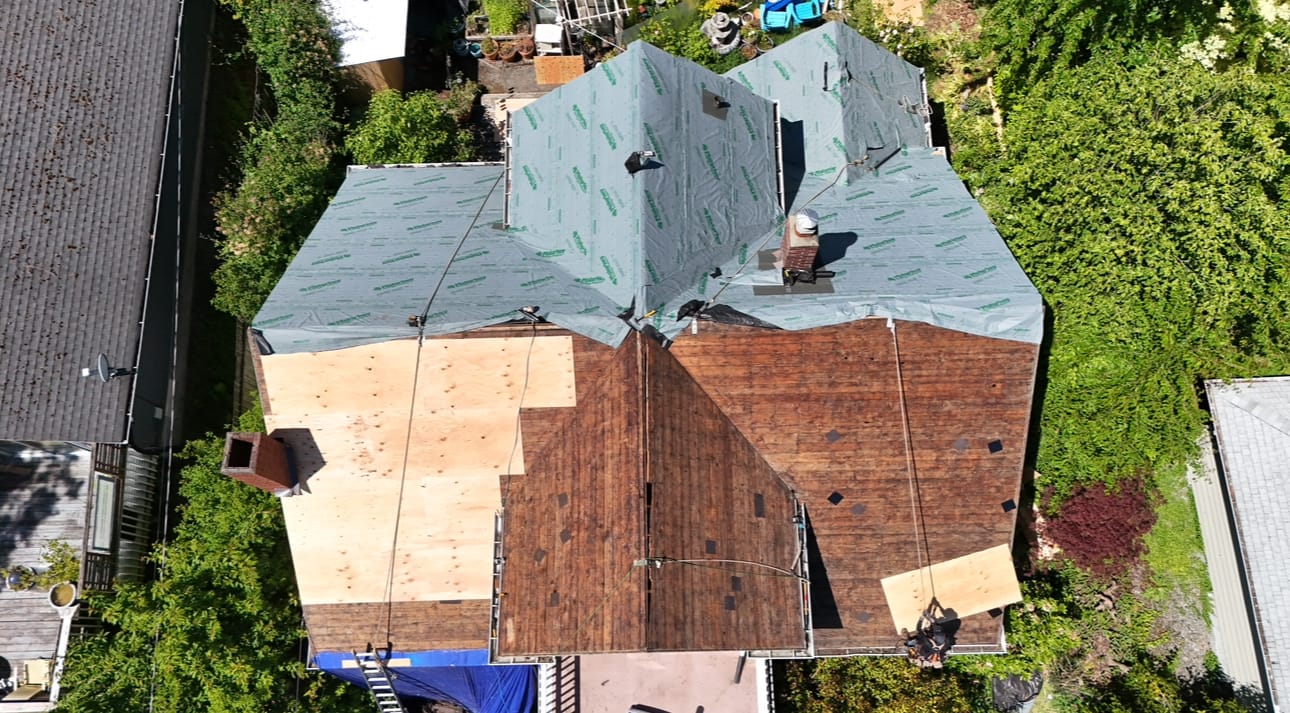
If you own a home in the Pacific Northwest with a cedar shake roof that is approaching the end of its life, you are facing a decision that thousands of PNW homeowners grapple with every year: install new cedar shake, or switch to composite? Both options give you the warm, textured shake aesthetic that defines so many neighborhoods across the Seattle area, but they differ significantly in maintenance requirements, cost over time, fire safety, and long-term performance. Here is an honest comparison to help you decide.
The Case for Cedar Shake
Cedar shake has been the roofing material of the Pacific Northwest for over a century, and its appeal is not hard to understand. Western Red Cedar is a natural material with warmth, depth, and character that cannot be perfectly replicated by any manufactured product. Each hand-split shake has unique grain patterns and texture. Over time, cedar weathers to the distinctive silver-gray patina that has become a visual signature of PNW neighborhoods from Capitol Hill to Bainbridge Island.
Beyond aesthetics, cedar offers genuine performance advantages. It provides roughly twice the thermal insulation value of asphalt shingles, which matters during PNW winters. Its natural oils resist insect and fungal damage. And when individual shakes are damaged, they can be replaced one at a time without disturbing the surrounding roof, a repairability advantage that few other materials offer.
The challenge with cedar is maintenance. In Western Washington’s wet climate, cedar shake requires consistent, proactive upkeep to reach its full lifespan potential. Moss treatment every one to two years, periodic preservative oil application, regular debris removal, and occasional individual shake replacement are all part of the deal. Homeowners who stay on top of this maintenance get 30 to 50 years from their cedar roof. Those who neglect it may see failure in as few as 15 to 20 years.
The Case for Composite Shake
Composite shake entered the market as a direct response to the maintenance frustrations of natural cedar. Products from manufacturers like DaVinci Roofscapes and Brava Roof Tile use engineered polymers molded from actual cedar shake profiles to create tiles that closely replicate the appearance of hand-split cedar, without the organic material that moss, moisture, and fire threaten.
The maintenance advantage is the primary selling point, and it is substantial. Composite shake requires essentially no ongoing maintenance beyond occasional debris clearing. Moss struggles to establish on the synthetic surface. There are no oils to reapply, no splits to repair, no fire-retardant treatments to renew. You install it and largely forget about it for the next four to five decades.
Composite also delivers a Class A fire rating, the highest possible classification, without any chemical treatment. For homeowners in areas with wildfire risk, or those who simply want maximum fire safety, this is a significant advantage over untreated cedar’s Class C rating.
Side-by-Side Comparison
| Factor | Cedar Shake | Composite Shake |
|---|---|---|
| Installed cost | $20,000 - $35,000 | $18,000 - $30,000 |
| Expected lifespan | 30 - 50 years | 40 - 50 years |
| Annual maintenance cost | $500 - $1,200 | $0 - $100 |
| Total 40-year cost | $40,000 - $83,000 | $18,000 - $34,000 |
| Fire rating | Class C (untreated), B-A (treated) | Class A |
| Moss resistance | Poor, requires ongoing treatment | Excellent |
| Appearance | Authentic natural wood | Very realistic manufactured |
| Repairability | Excellent, individual shake replacement | Good, individual tile replacement |
| Environmental | Natural, renewable, biodegradable | Engineered polymer, some recycled content |
| Warranty | 20 - 30 years typical | 50 years (transferable) |
| Insurance impact | Higher premiums possible (untreated) | Standard or reduced rates |
The total cost of ownership comparison is often the deciding factor. Even when upfront costs are similar, the cumulative maintenance savings over 40 years make composite dramatically less expensive over the full life of the roof. A homeowner spending $800 per year on cedar maintenance will spend an additional $32,000 over 40 years, money that composite owners never need to spend.
Appearance: How Close Is Close Enough?
This is the most subjective question in the comparison, and there is no universal answer. Modern composite shake tiles are manufactured using molds taken from real hand-split cedar, and they capture grain patterns, split textures, and natural irregularities with impressive accuracy. Multi-toned color blending adds to the realism.
From the street, which is how most people experience a roof, quality composite shake is very difficult to distinguish from genuine cedar. The difference becomes more apparent at close range, where composite lacks the organic depth, tactile warmth, and subtle grain variations of real wood. It is the difference between a high-quality reproduction and an original.
Some homeowners find the visual difference negligible. Others feel strongly that only real cedar delivers the authentic character they want for their home. Neither perspective is wrong. The question is how much the difference matters to you versus the maintenance and cost implications.
Fire Safety: A Growing Concern
Fire safety has become an increasingly important consideration for PNW homeowners. While the Seattle metropolitan area is not a high-wildfire-risk zone, recent dry summers have brought wildfire smoke and fire awareness closer to the Puget Sound region. Homes with untreated cedar shake roofs (Class C fire rating) are more vulnerable to ember ignition during wildfire events and from other fire sources.
Composite shake’s Class A fire rating provides the highest level of fire resistance without any chemical treatment. Fire-retardant treated cedar can achieve Class B or A ratings, but the treatment adds cost upfront and may need renewal after 15 to 20 years.
Some insurance companies charge higher premiums for homes with untreated cedar shake roofs. Switching from untreated cedar to composite or fire-retardant treated cedar may qualify you for a rate reduction. It is worth checking with your insurance provider when weighing options.
HOA Considerations
Many PNW neighborhoods with homeowner associations have architectural covenants that specify roofing materials. Historically, some of these covenants required natural cedar shake to maintain neighborhood character. As composite products have matured and built a track record, most HOAs in the Seattle area have updated their covenants to accept composite shake as an approved alternative.
If your neighborhood has an HOA, check the current architectural guidelines before making a decision. If composite is not explicitly listed as approved, submit product samples and manufacturer specifications to the architectural review committee. In our experience, most PNW HOAs approve quality composite shake when presented with the product.
Environmental Considerations
This is one area where cedar holds a genuine advantage. Western Red Cedar is a natural, renewable resource that is biodegradable at end of life. Cedar roofing has a lower embodied energy footprint than manufactured products, and sustainably harvested cedar from managed forests represents a responsible material choice.
Composite roofing is manufactured from engineered polymers, essentially plastic, though some products incorporate recycled content. At end of life, composite tiles are not biodegradable and must be disposed of in a landfill. While the longer lifespan and lack of maintenance chemicals partially offset this environmental cost, environmentally motivated homeowners should weigh this factor.
Which Should You Choose?
Choose cedar shake if:
- Authentic natural material character is a top priority for you
- You are willing and able to commit to consistent annual maintenance
- Environmental sustainability and biodegradability matter to you
- Your home is in a neighborhood where genuine cedar is part of the architectural heritage
- You enjoy hands-on home maintenance and see it as part of homeownership
Choose composite shake if:
- You want the shake aesthetic without the ongoing maintenance commitment
- Fire safety is important to you and you prefer Class A without chemical treatment
- You want the lowest total cost of ownership over 30 to 50 years
- You are replacing an aging cedar roof and maintenance fatigue is a factor
- Your HOA requires a shake appearance but you prefer manufactured durability
We Install Both: Honestly
At K Single Corp, we install both genuine cedar shake and composite shake roofing across the Greater Seattle Area. We are not invested in steering you toward one material over the other. Our recommendation is based on your priorities, your budget, your maintenance preferences, and what makes sense for your specific home and neighborhood. Contact us at (206) 659-4349 for a free consultation where we will bring physical samples of both materials to your home so you can see and feel the difference firsthand.